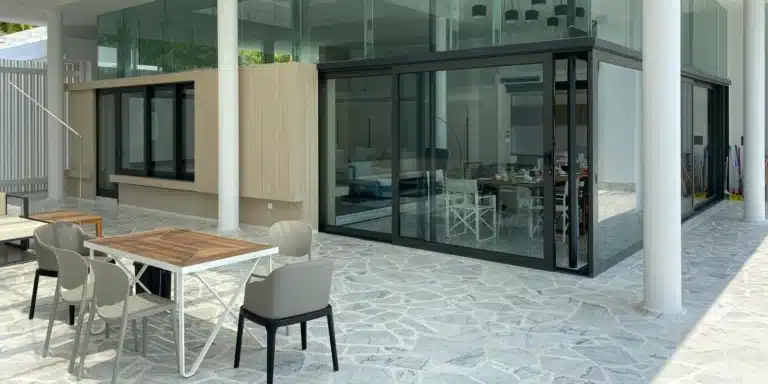
Aluminum vs vinyl sliding doors is really a project-fit decision. Vinyl sliding doors are often practical for standard patio replacements, budget-sensitive projects, and basic residential use. Thermally broken aluminum sliding doors are usually better for modern homes that need larger glass panels, slimmer frames, stronger profiles, cleaner sightlines, and long-term architectural value.
Choosing between aluminum and vinyl sliding doors is not just about which frame material is “better.” The right answer depends on the opening size, climate exposure, budget, design style, energy-performance expectations, and how important the door is to the home’s architecture.
Vinyl sliding doors are popular because they are usually affordable, low maintenance, and naturally less conductive than metal. For many standard patio door replacements, that combination is enough.
Thermally broken aluminum sliding doors solve a different problem. They keep the strength and slim-frame potential of aluminum while using a thermal barrier to reduce the heat-transfer weakness of traditional aluminum frames. That makes them more relevant for large openings, narrow sightlines, custom modern homes, and high-end indoor-outdoor living spaces.
This guide compares aluminum vs vinyl sliding doors by material structure, energy efficiency, strength, sightlines, durability, drainage, cost, and project fit. It also gives you a practical checklist for comparing quotes without overbuying or underspecifying the door system.
Scene: A homeowner and architect are reviewing a rear living-room elevation for a modern home. The design calls for a wide sliding opening facing the patio and garden.
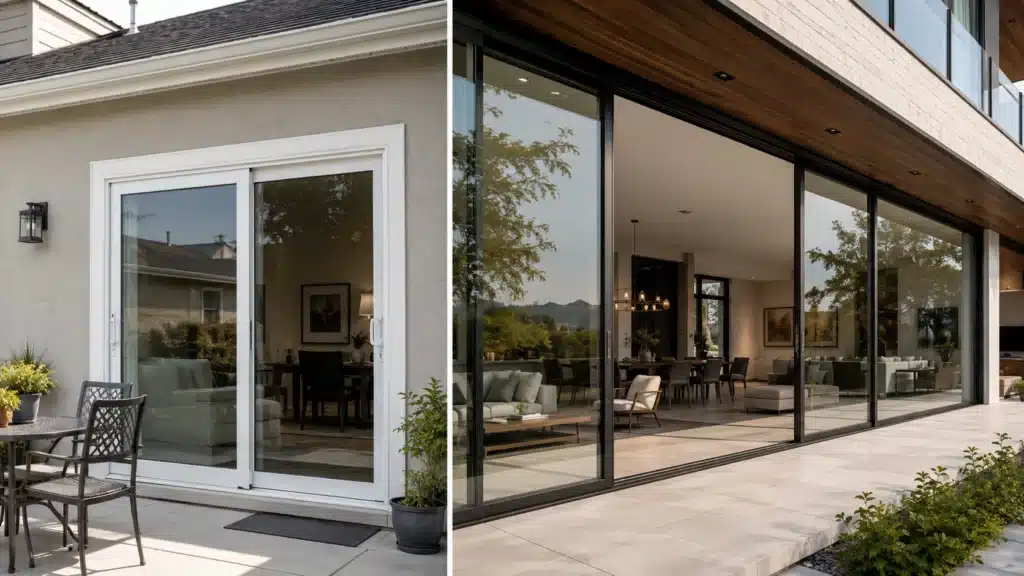
What you notice: The vinyl sample looks practical, but the frame feels visually heavier. The thermally broken aluminum sample creates a cleaner view and makes the opening feel more architectural.
What’s really happening: Frame material, profile width, panel size, and structural limits are shaping the experience before the door is even installed.
What to do next: Compare actual sightlines, glass size, drainage details, performance documentation, and installation requirements—not just the material name.
Aluminum vs Vinyl Sliding Doors: Quick Comparison
The simplest way to compare aluminum and vinyl sliding doors is to separate standard replacement needs from architectural design needs. Vinyl is often the practical choice for basic patio openings. Thermally broken aluminum becomes more relevant when the sliding door is a major visual and structural element of the home.
| Comparison Point | Vinyl Sliding Doors | Thermally Broken Aluminum Sliding Doors |
|---|---|---|
| Best Use | Standard patio replacements, budget-sensitive projects, rental homes | Modern homes, large openings, slim-frame designs, custom projects |
| Energy Efficiency | Good baseline potential because vinyl is naturally less conductive than metal | Depends on the thermal break, glass package, seals, and whole-system ratings |
| Strength | Suitable for many standard residential sizes | Better suited for larger panels and slimmer structural profiles |
| Appearance | Often thicker and more traditional in frame proportion | Cleaner sightlines and a more modern architectural look |
| Maintenance | Low maintenance and easy to clean | Low maintenance when finish, drainage, and hardware are properly specified |
| Cost | Usually lower upfront cost | Usually a premium option for custom or high-end projects |
Bottom line: vinyl is often the value choice for standard openings. Thermally broken aluminum is often the design-performance choice for modern homes, larger glass, and long-term architectural value.
What Aluminum and Vinyl Sliding Doors Are Made Of
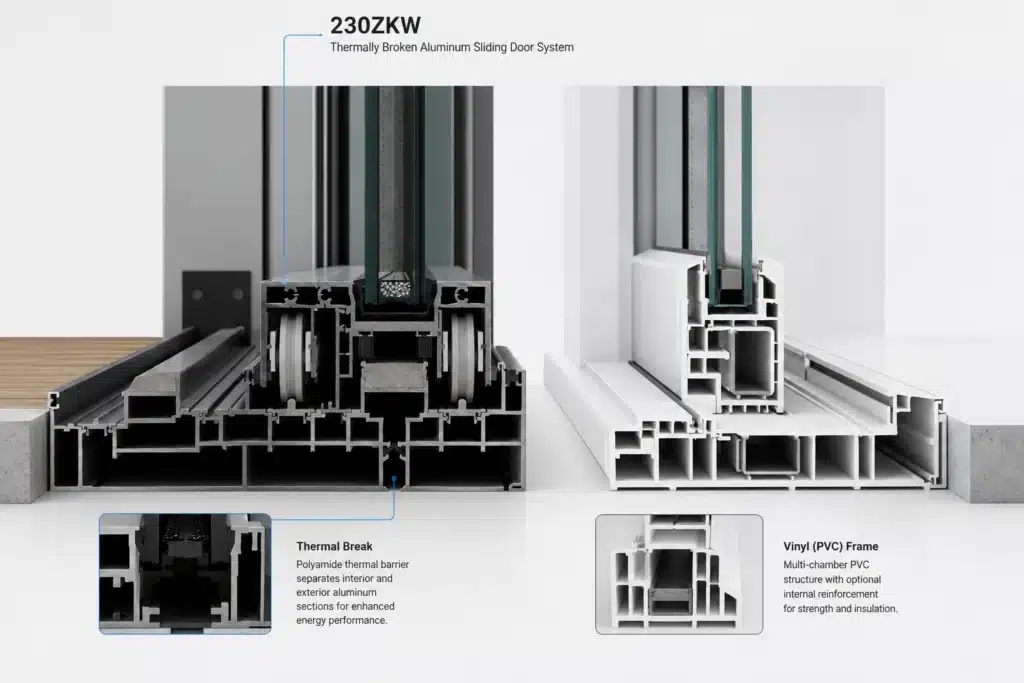
Vinyl sliding doors are usually made from PVC-based frame profiles. Many vinyl frames use internal chambers, and some products may include reinforcement depending on size, color, hardware load, and design. Vinyl is naturally less conductive than metal, which helps explain its popularity in residential replacement doors.
Traditional aluminum sliding doors are strong and slim, but basic aluminum conducts heat quickly. That is why a high-performance modern aluminum door should not be compared as a simple metal frame. The more relevant comparison is thermally broken aluminum sliding doors.
A thermally broken aluminum sliding door uses an insulating barrier between the interior and exterior aluminum sections. This thermal break helps reduce direct heat transfer through the metal frame while keeping aluminum’s strength, stability, and slim-profile potential.
What to verify
- Is the aluminum frame thermally broken or non-thermally broken?
- Does the vinyl frame include reinforcement for larger panels or darker finishes?
- Are the ratings based on the whole door system or only the glass?
- Does the quote include the correct glass, hardware, sill, and installation details?
Common mistake
Do not compare a basic vinyl patio door with a custom thermally broken aluminum system only by price. They may be solving very different project problems.
Energy Efficiency: Vinyl vs Thermally Broken Aluminum Sliding Doors
Energy efficiency is one of the most misunderstood parts of the aluminum vs vinyl sliding doors comparison. Vinyl often has a natural frame-material advantage because PVC conducts less heat than metal. But that does not mean every vinyl sliding door automatically performs better in the home.
Thermally broken aluminum sliding doors are designed to reduce the traditional thermal weakness of aluminum. The thermal barrier separates the interior and exterior aluminum sections, helping limit direct heat transfer through the frame.
The final result depends on the complete door system: glass package, spacer, frame design, seals, sill, air leakage control, and installation quality.
What to verify
- U-Factor: Helps compare heat transfer through the whole product.
- SHGC: Shows how much solar heat passes through the glass system.
- Visible Transmittance: Helps compare daylight and view clarity.
- Air Leakage: Important for comfort, drafts, and noise control.
- Configuration-specific documentation: Ask whether the tested information applies to the exact system being quoted.
NFRC certification is available for specific system configurations based on project requirements.
Common mistake
Do not assume “vinyl” always means comfortable or “aluminum” always means cold. A poorly installed vinyl door can leak air. A well-designed thermally broken aluminum system with the right glass, seals, and installation can perform very differently from a basic non-thermal aluminum door.
Strength, Sightlines, and Large Openings in Aluminum vs Vinyl Sliding Doors
When the opening is small and standard, vinyl sliding doors can work well. When the opening becomes larger, more visible, and more important to the architecture, the frame system has to do more work.
Aluminum has a strong stiffness-to-profile advantage. That means thermally broken aluminum sliding doors can often support larger glass panels and slimmer visible frame lines than many standard vinyl systems. This is one reason aluminum systems are common in modern homes where the goal is more glass, better views, and cleaner indoor-outdoor transitions.
Vinyl can still be a good solution for many normal patio openings. But as the door gets larger, vinyl frames may need thicker profiles, reinforcement, or more conservative size limits. That can affect both appearance and operation.
What to verify
- Visible frame width and interlock sightline drawings
- Maximum panel size for the selected system
- Glass weight and roller capacity
- Locking points and seal compression
- Track design, sill support, and installation tolerance
Product Fit Example: 230ZKW for Narrow-Frame, Large-Opening Sliding Doors
For projects where the goal is not just to replace a patio door but to create a cleaner architectural opening, a narrow-frame sliding door system can make a visible difference. The 230ZKW system is positioned for modern residential and architectural projects that need slim sightlines, larger glass panels, and a refined indoor-outdoor connection.
Its value is not only visual. A large sliding door also needs practical operation, frame stability, roller support, drainage design, and installation coordination. This is where a dedicated thermally broken aluminum sliding door system can be a better fit than a basic replacement patio door.
Common mistake
The goal should not be the narrowest frame at any cost. The goal should be the narrowest appropriate frame for the panel size, glass weight, site exposure, drainage path, and installation conditions.

Durability, Drainage, and Maintenance in Aluminum vs Vinyl Sliding Doors
Durability means more than how long the material lasts. For sliding doors, durability also means the frame stays aligned, the finish remains stable, the seals keep contact, the rollers operate smoothly, and the sill manages water properly.
Vinyl sliding doors are low maintenance and moisture resistant. They do not need painting, and everyday cleaning is usually simple. For standard openings and protected locations, this can be a strong advantage.
Thermally broken aluminum sliding doors are often better suited for projects that require larger panels, darker finishes, slimmer frames, or stronger long-term visual stability. Their performance depends on the finish, drainage design, hardware, seals, and installation—not the aluminum material alone.
Why drainage matters
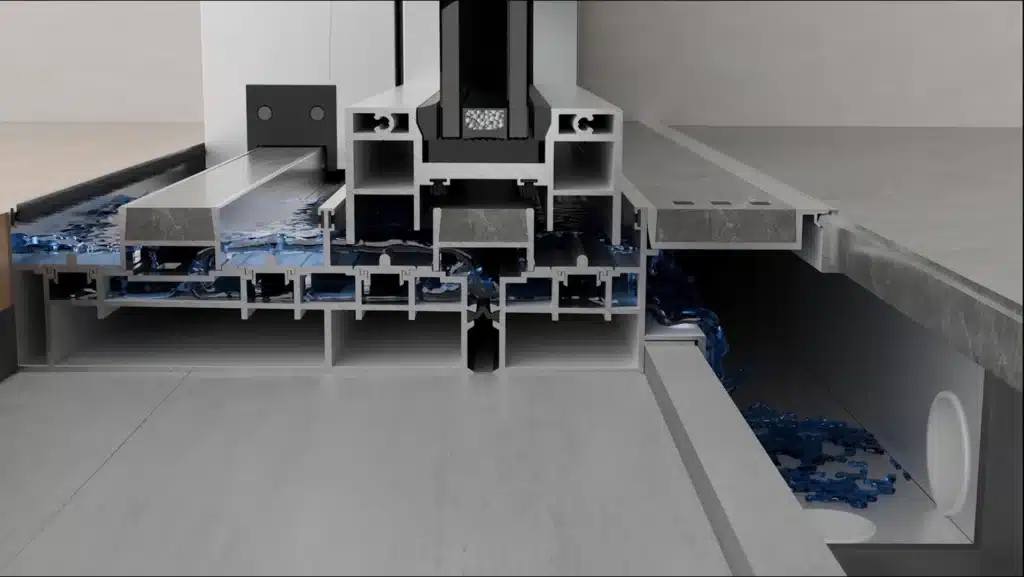
A sliding door sits on a track. That means water, debris, patio runoff, cleaning water, and wind-driven rain can all interact with the sill. If drainage is not considered early, even a beautiful door can become a maintenance problem.
For exposed patios, terraces, pool areas, and wide exterior openings, ask how the sill collects and directs water. Review the weep path, exterior slope, waterproofing detail, and track-cleaning access.
Product Fit Example: Beauty and Usability Together
The 230ZKW system is a useful reference when a project needs narrow-frame aesthetics, larger panel design, and practical drainage performance in one sliding door system. For modern homes, the best door is not only the one that looks clean in photos. It also needs to operate smoothly, manage water, and remain usable in daily life.
Common mistake
Do not treat drainage as a small installation detail. For large sliding doors, drainage should be reviewed as part of the system design, along with the sill section, track layout, exterior surface, and waterproofing route.
Noise, Comfort, and Air Leakage in Aluminum vs Vinyl Sliding Doors
Noise reduction is not decided by frame material alone. A sliding door’s acoustic comfort depends on glass type, laminated glass options, seal contact, interlock design, sill detail, air leakage control, and installation quality.
The same is true for drafts. A door can have a good frame material and still feel uncomfortable if air leaks around the panel, meeting rail, sill, or rough opening. Because sliding panels need to move, sealing strategy is especially important.
What to verify
- Does the quoted performance apply to the whole door system?
- How does the sliding panel seal when closed?
- Do locking points help improve compression?
- Is the sill level, supported, and protected against water intrusion?
- For noisy sites, is laminated glass being compared together with air-sealing details?
For a deeper explanation, see acoustic glass vs airtight sliding doors.
Common mistake
Do not buy “better glass” while ignoring leakage paths. A stronger glass package cannot fully solve comfort or noise issues if the door leaks air around the panel or perimeter.
Cost and Best Use Cases for Aluminum vs Vinyl Sliding Doors
Vinyl sliding doors usually have the lower upfront cost. For standard patio replacements, budget-sensitive projects, rentals, and basic residential openings, vinyl can be the sensible choice.
Thermally broken aluminum sliding doors are usually a premium option. The cost is influenced by custom sizing, glass package, frame finish, hardware, drainage design, panel weight, and installation complexity.
The better question is not “Which material is cheaper?” The better question is “Which system fits the project without creating long-term compromise?”
| Project Type | Usually Better Fit | Reason | What to Verify |
|---|---|---|---|
| Standard patio replacement | Vinyl sliding doors | Budget-friendly and practical for many normal openings | Whole-door ratings, installation scope, warranty |
| Rental or short-term remodel | Vinyl sliding doors | Good value when basic function matters more than architectural appearance | Frame quality, hardware, weatherstripping |
| Modern custom home | Thermally broken aluminum sliding doors | Better fit for slim sightlines, larger glass, and refined design | Frame drawings, glass package, sill design, tested configuration |
| Large rear living-room opening | Thermally broken aluminum sliding doors | Stronger frame system can better support wide glass and clean visual lines | Panel size limits, roller capacity, drainage, installation tolerance |
| Exposed patio, terrace, or pool area | Project-dependent, often thermally broken aluminum for custom work | Exposure increases the importance of stiffness, drainage, finish, and sealing strategy | Water management, finish durability, hardware, local exposure |
Common mistake
Do not choose vinyl for every budget project or aluminum for every high-end project. Match the door to the opening, exposure, design goal, expected lifespan, and documentation available for the specific configuration.
Aluminum vs Vinyl Sliding Doors Checklist
Use this checklist before comparing final quotes:
- Confirm whether the aluminum system is thermally broken.
- Check whether the opening is standard-size or architectural-scale.
- Review the glass package, not only the frame material.
- Ask for whole-product ratings where available.
- Compare visible frame width and actual sightline drawings.
- Confirm panel size limits, glass weight, roller capacity, and locking design.
- Review sill drainage, weep paths, and exterior slope conditions.
- Ask how the door controls air leakage at the panel, sill, and perimeter.
- Compare total installed cost, including waterproofing, trim, finish repair, and labor.
- Match the door system to how long the owner plans to stay in the home.
Decision Framework: How to Choose Aluminum vs Vinyl Sliding Doors
- Start with the opening. Standard and protected openings often suit vinyl. Large and highly visible openings often justify thermally broken aluminum.
- Define the design priority. If lowest upfront cost is the goal, vinyl often wins. If slim frames and large glass matter, aluminum becomes more relevant.
- Review exposure. Wind, rain, sun, coastal air, and patio drainage all affect the right system choice.
- Separate glass performance from door performance. Glass matters, but seals, sill, frame, and installation matter too.
- Compare the exact configuration. Ask for documentation that applies to the actual size, glass, frame, and hardware being specified.
Considering Thermally Broken Aluminum Sliding Doors for a Modern Home?
If your project involves large glass openings, slim frame expectations, exterior exposure, or a modern indoor-outdoor layout, compare standard vinyl patio doors with a dedicated thermally broken aluminum sliding door system before making the final specification.
For projects where beauty and usability need to work together, the 230ZKW system can be positioned as a narrow-frame, large-opening sliding door solution with practical drainage design for real residential use.
Frequently Asked Questions About Aluminum vs Vinyl Sliding Doors
Are aluminum sliding doors better than vinyl sliding doors?
Not always. Vinyl sliding doors are often better for standard patio openings and budget-sensitive replacements. Thermally broken aluminum sliding doors are usually better for modern homes, larger glass panels, slimmer frames, and custom architectural openings.
Are vinyl sliding doors more energy efficient than aluminum sliding doors?
Vinyl frames usually have a natural thermal advantage because PVC conducts less heat than metal. However, thermally broken aluminum sliding doors are designed to reduce the heat-transfer weakness of traditional aluminum. The best comparison should use whole-product ratings for the exact door configuration.
What is the difference between aluminum and thermally broken aluminum sliding doors?
Traditional aluminum sliding doors use metal frames that can conduct heat quickly. Thermally broken aluminum sliding doors include a thermal barrier between the interior and exterior aluminum sections, helping reduce direct heat transfer through the frame.
Are aluminum sliding doors good for large openings?
Thermally broken aluminum sliding doors are often a strong candidate for large openings because aluminum can support slimmer and stronger frame profiles. For large panels, always verify panel size limits, roller capacity, glass weight, sill drainage, and installation requirements.
Are vinyl sliding doors cheaper than aluminum sliding doors?
Vinyl sliding doors are usually more budget-friendly for standard residential replacements. Thermally broken aluminum sliding doors are typically a premium option, especially when the project requires custom sizing, narrow frames, large panels, upgraded glass, or detailed installation coordination.
Which sliding door material is better for modern homes?
For modern homes where the sliding door is a major design feature, thermally broken aluminum sliding doors are often the stronger choice. They can better support narrow sightlines, larger glass areas, and cleaner architectural proportions. Vinyl can still be a good fit when the opening is standard and budget control is the main priority.