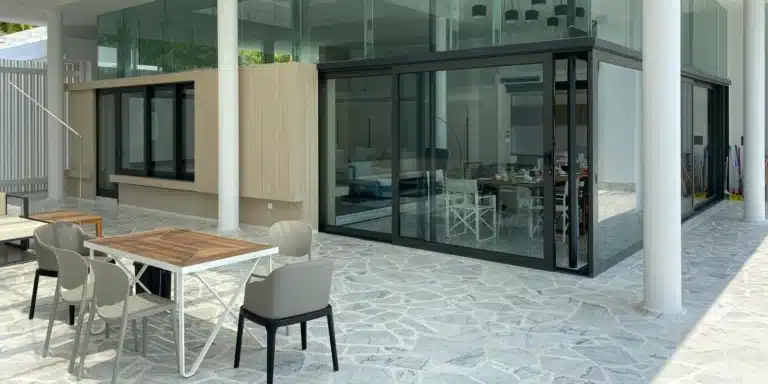
Aluminum door systems are foundational to modern architectural projects requiring expansive glass, optimized energy performance, and minimal sightlines. In settings ranging from luxury residences and high-rises to commercial installations, the selection between lift & slide doors and traditional sliding door systems shapes the usability, aesthetics, and regulatory compliance of the space.
Lift & slide door engineering and architectural solutions enable effortless movement of exceptionally large, heavy glass panels while maintaining airtight and secure enclosure. In contrast, conventional sliding systems offer a more straightforward mechanism appropriate for moderate spans, cost-focused applications, and utility-based installations. Assessing which system to specify involves considering project load requirements, thermal targets, wind load compliance, and lifecycle operational integrity.
In this technical analysis, each system is examined for its engineering characteristics, certified performance, and practical deployment – supported by measured data and referenced to industry standards.
System Definitions and Differentiators
Lift & slide and sliding doors share superficial similarities, but their core mechanisms, engineering tolerances, and performance profiles differ substantially.
Lift & Slide Doors
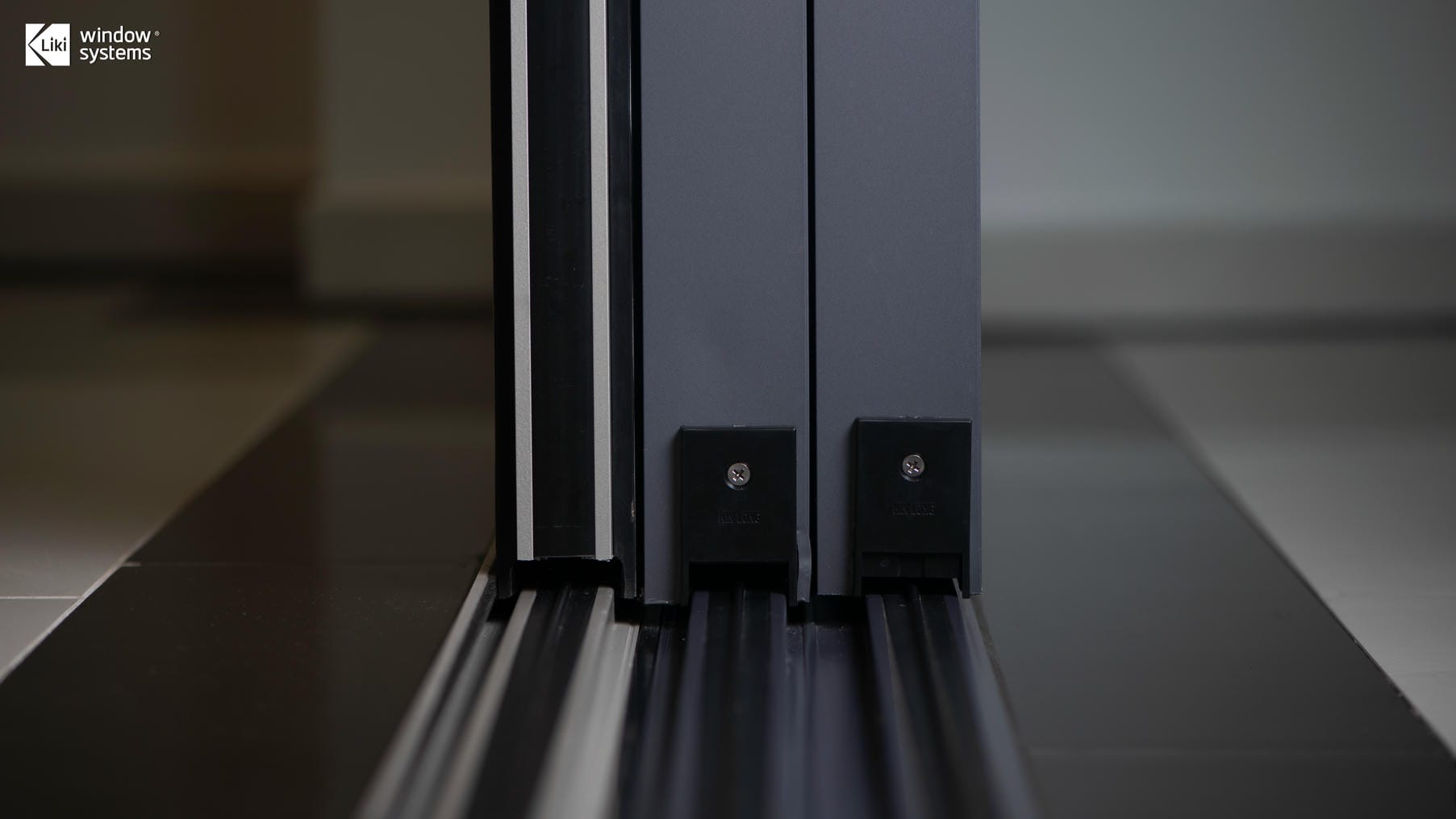
Lift & slide doors are precision-engineered with a cam-driven handle that, when rotated, elevates the panel a precise distance (typically 6–8 mm) off the track. This separation nearly eliminates rolling friction, enabling movement of panels weighing up to 1300 lbs (590 kg) with a gentle push. When the handle returns to the lock position, the panel settles into the frame, compressing EPDM triple-seal gaskets and creating an airtight, water-resistant barrier with air infiltration rates tested below 0.1 CFM/ft and water penetration resistance up to 550 Pa. Multi-chamber thermally broken aluminum profiles with Technoform® polyamide barriers deliver outstanding insulation, supported by U-Factor and SHGC certification under NFRC and ASTM protocols. These attributes place lift & slide doors at the forefront of large-span, performance-driven fenestration for premium projects.
Traditional Sliding Door Systems
Sliding doors employ a direct, inline rolling track, with the panel continuously resting on, and moving along, the lower rail. This construction is inherently simpler but introduces greater rolling friction, especially as panel weight increases. Most sliding systems handle lighter glass (generally below 200–300 lbs), use single or dual-lip weather seals, and achieve basic air and water tightness. These systems are often specified for patios, balconies, and budget-conscious installations where expansive spans, stringent weather resistance, or advanced security are not required fundamentals.
Key System Differences
- Mechanism: Lift & slide separates lifting and gliding; traditional sliding uses permanent contact rolling.
- Sealing: Lift & slide delivers triple-compression EPDM gaskets with engineered closing force; sliding relies on single or brush seals.
- Panel Size: Lift & slide supports vastly larger/heavier panels (up to 1300 lbs, 3m+ high); sliding systems are limited by rolling friction and track stress.
- Security: Multi-point locking with GU, Roto, or Sobinco hardware is native to lift & slide; sliding doors have simpler locking and are easier to force open.
- Energy Performance: Lift & slide is thermally optimized and standards-certified; sliding may lack adequate breaks or verified data.
- Common Uses: Lift & slide fits architectural feature walls and technically demanding projects; sliding doors serve smaller, lower-load openings.
For system-specific features and validated data, see LIKI’s lift & slide door engineering and architectural solutions and sliding door system types and performance details.
Operational Mechanisms and Engineering Function
Understanding the mechanics clarifies why these systems behave differently in use and over time.
Lift & Slide Operational Principles
- Handle Function: Rotating the handle engages a cam drive that lifts the door panel several millimeters.
- Friction Reduction: As the panel elevates, high-performance stainless steel or composite rollers carry the load, enabling ultra-smooth sliding of panels up to 1300 lbs.
- Compression Sealing: Closing the handle lowers the panel into the frame, compressing EPDM triple-gasket perimeters for maximum airtightness and water resistance.
- Security Integration: Built-in multi-point locks engage at several points, activating robust intrusion resistance in combination with panel mass.
- Tolerances and Manufacturing: CNC precision enables ±0.2 mm alignment, which is critical for effective lift engagement and sealing compression throughout years of operation.
Traditional Sliding Mechanism
- Constant Rolling: Doors ride directly on track-set rollers. Panel weight bears down continuously, increasing rolling friction proportionally.
- Seal Contact: Simple gaskets (brush or single-lip EPDM) are always exposed, providing a variable and sometimes unreliable perimeter seal.
- Single-Locking: Standard latching is single-point, less secure against forced entry.
- Wear Factors: As tracks accumulate debris or seals wear, opening and closing force increases; panels may stick or rattle over time.
- Typical Loads: Intended primarily for modest panel sizes and lighter glass.
Critical Factors in Direct Comparison

Below, a detailed side-by-side summary emphasizes the engineering, security, performance, and cost implications for professional specification.
| Attribute | Lift & Slide Doors | Sliding Doors |
|---|---|---|
| Movement | Panel is lifted, glides smoothly even at large panel weights | Panel rolls directly, effort increases with size |
| Sealing/Airtightness | Triple EPDM compression, test rates <0.1 CFM/ft, water resistance up to 550 Pa | Simple seals, higher air/water infiltration |
| Thermal Performance | Multi-chamber thermal breaks, NFRC/ASTM certified U-Factor/SHGC | Basic or absent thermal breaks, testing varies |
| Panel Limits | Up to 1300 lbs/3m+ height per sash, multi-panel capability | Typically <200–300 lbs, smaller max panel size |
| Security | Multi-point locking, panel mass aids resistance | Single latch (multi-point available at add’l cost) |
| Durability | Seals disengaged during opening, minimal wear, rated >50,000 cycles | Seals/rollers wear with use, cleaning frequent |
| Structural Ratings | Up to DP 94 PSF, tested for wind/hurricane zones | Lower DP; check technical sheets |
| Cost | Premium (typically 50%+ over basic slider) | Entry-level, budget-focused |
| Maintenance | Low; needs periodic seal check and lubrication | Track/roller cleaning essential; frequent care |
| Applications | Architectural highlights, exposed climates, energy-code projects | Patios, balconies, interior separations |
Operation and Ease of Use
Lift & Slide:
- Handle acts as both unlock and lift. Large panels can be opened by nearly anyone.
- Zero-gravity glide mechanics – minimal rolling resistance, even with triple glazing or advanced security mesh.
- No drag or binding as the hardware is rated for up to 1300 lbs per moving panel.
Sliding:
- Initial action smooth with light panels, but friction and sticking increase as debris collects or seals compress.
- Larger panels may become laborious to move.
- Operation and closure less precise, leading to draft or rattle under wind load.
Sealing, Insulation, and Certified Performance
Lift & Slide:
- Compression sealing ensures both low air infiltration and superior weather resistance.
- Technoform® multi-chamber thermal breaks maximize insulation; independently certified for U-Factor and SHGC under NFRC/ASTM.
Sliding:
- Seals are always engaged, leading to gradual deterioration and increased leakage.
- Lack of true compression leads to higher energy loss, especially in climates with significant temperature differentials.
- Standards compliance variable – confirm by manufacturer documentation.
Planning a Large-Span Architectural Project?
Our engineering team can provide custom CAD shop drawings and NFRC energy data to ensure your door system meets both your vision and local building codes.
Security and Locking Systems
Lift & Slide:
- Integrated multi-point locks, often using GU, Roto, or Sobinco components.
- Panel mass and lock distribution create strong resistance to prying or lifting.
- Security mesh in 316 stainless steel can enhance forced-entry performance.
Sliding:
- Basic latch or single-point lock common; multi-point possible with upgraded hardware.
- As panels are lighter and perimeter seal is less robust, forced entry is a more realistic threat.
Space Planning and Panel Sizing
Lift & Slide:
- Enables use of ultra-large glass panels for panoramic views and architectural impact.
- Multi-track options support wide clear openings; custom RAL, woodgrain, and geometry options expand creative possibilities.
Sliding:
- Suited to standard door spans, smaller heights, or projects with structural limits.
- Custom configurations possible, but constrained by hardware and system design.
Durability and Maintenance Profile
Lift & Slide:
- Minimal seal and roller wear due to elevated travel; critical for high-cycle or exposed locations, including coastal or urban settings.
- AkzoNobel® powder coatings extend finish life under harsh environmental impact.
Sliding:
- Seal wear, debris accumulation, and rolling resistance necessitate closer attention.
- Common failure points are rollers, guides, and degraded weather seals.
Lifecycle Cost Considerations
- Lift & Slide: Higher initial cost, balanced with low maintenance, long service intervals, and substantial energy savings, particularly in energy-intensive climates or high-specification projects.
- Sliding: Lower upfront cost, but cumulative maintenance and potential for premature replacement must be weighed in total project budgeting.
Advantages and Limitations: System-by-System Analysis
To aid specification and engineering decisions, the following matrices summarize advantages and constraints.
Lift & Slide Doors
Advantages
- Handles extra-large, heavy glazing up to 1300 lbs, enabling design freedom for panoramic and floor-to-ceiling assemblies.
- Achieves exceptional airtightness/water resistance meeting or surpassing code for severe climates and wind-exposed sites.
- Delivers best-in-class thermal insulation via Technoform® multi-chamber breaks and triple compression gaskets.
- Outfitted with robust multi-point locking systems for increased security.
- Minimal wear to rollers and seals during use; tested for 50,000+ cycles under real load.
- Durable AkzoNobel® finishes offer color flexibility and longevity, supporting diverse design intent.
- Verified structural ratings up to DP 94 PSF.
- Full compliance with NFRC, ASTM, and AAMA standards.
Limitations
- Higher initial investment required (approximately 50%+ over standard sliding).
- Demands skilled installation to uphold tolerances, proper sealing, and handle alignment.
- Weight and complexity can constrain suitability for some retrofit or modest-scale projects.
Sliding Doors
Advantages
- Simple mechanism, often faster to install.
- Lower upfront materials and fabrication costs.
- Effective use of space – well-suited for patios, balconies, room dividers, and light-duty exposures.
- Appropriate for small-to-medium glass panels within traditional residential and commercial settings.
Limitations
- Inferior to lift & slide in air and water tightness, especially as hardware/frames age.
- Panel size limited by rolling hardware and friction; not engineered for very large spans.
- Single-point latch provides lower security baseline.
- Maintenance needs increase over time, especially in demanding environments.
For further structural, design, or performance comparisons, review LIKI’s complete aluminum window and door systems catalog.
Application Guidance: When to Specify Each Door Type
Selecting between lift & slide and traditional sliding doors requires integrating climate exposure, structural needs, operational demands, and budget.
Climate and Weather Resistance
- For exposed sites (seafronts, high-rise, hurricane-prone regions), lift & slide systems achieve top ratings in air/water tightness and structural load, tested up to DP 94 PSF and water resistance of 550 Pa.
- In more moderate climates or interior environments, sliding doors may prove sufficient.
Panel Weight, Size, and Glass Specification
- Lift & slide systems are optimal for installations seeking oversized openings, heavy glazing (triple-pane, impact-rated glass), or bespoke geometric arrangements.
- Sliding systems handle standard weights and sizes, ideal for residential patios or moderate-traffic entries.
Security and Site Use Profiles
- Where high security is paramount (luxury homes, ground floor exposures), lift & slide platforms deliver definite advantage.
- For utility doors or low-burden spaces, sliding doors meet functional needs with basic upgrades.
Budgetary and Long-Term Costs
- Lift & slide offers greater lifecycle value in tough climates or primary door locations; initial cost is offset by decades of high performance and reduced maintenance.
- Sliding doors, while less expensive upfront, may incur frequent service or possible early replacement on intensive sites.
Consultation with project engineers and review of testing and certification is essential for compliance in regulated applications. Refer to the professional toolkit with shop drawings and NFRC energy data for further resource support.
Note: The information in this section is for general technical guidance only. Consultation with qualified professionals is advised for site-specific design, installation, and regulatory compliance.
Installation and Maintenance Protocols
Long-term door performance is guaranteed only where commissioning and ongoing care meet the precision standards of advanced aluminum fenestration.
Installation: Key Procedures
- For lift & slide mechanisms, verify track flatness and level within ±0.2 mm to ensure correct handle lift function and proper seal engagement.
- Validate frame plumbness and rack resistance with calibrated instruments.
- Bench test full lock/lift operation prior to final panel glazing.
- Employ substrate-appropriate anchoring, nailing fins, and compatible sealants.
- Confirm synchronization of multi-point locks, and test each locking position for full engagement.
Maintenance Checklist
- Track and Roller Care: Vacuum and wipe tracks quarterly; avoid oil-based lubricants that attract grit. Use approved, non-staining lubricants biannually.
- Seal Inspection: Every 2–3 years (or before seasonal weather extremes), check EPDM seals for compression, elasticity, and visual wear. Replace per manufacturer protocol if deterioration is present.
- Roller/Hardware Review: Inspect for smooth operation; replace rollers (certified replacement parts only) if drag or flat-spots are evident.
- Handle/Lift Mechanisms: Cycle handle through lift and lock positions; listen and feel for resistance or clicks outside design parameters.
Technical Support and Resources
- Access the LIKI detailed section drawings, installation guides, and performance test reports to ensure system specification and install procedures match factory recommendations.
- For specialist applications or unique site constraints, collaborate with LIKI technical services and project engineering teams using the professional toolkit with shop drawings and NFRC energy data.
Frequently Asked Questions
How does a lift & slide mechanism enhance door performance?
By disengaging the panel from the frame during movement, it enables extremely heavy glass sashes to slide easily with minimal force. Once closed, the panel compresses high-performance seals, vastly improving air and water tightness.
Do lift & slide doors provide measurable energy improvement?
Yes. Certified thermal performance data from NFRC and ASTM tests support that properly specified lift & slide systems outperform most traditional sliders on U-Factor and SHGC, lowering HVAC loads.
Is security truly greater with lift & slide vs. sliding?
Lift & slide’s multi-point locking, reinforced hardware, and massive sash weight present a formidable barrier to forced entry – much more than a single latch slider.
What are the physical limits for each system?
Lift & slide: up to 1300 lbs panel mass, heights over 3 meters.
Sliding: usually <300 lbs and heights below 2.5 meters unless system is specially engineered.
Why do sliding doors require frequent maintenance?
Continuous contact with the track allows for debris ingress. Rollers and seals wear down more quickly than in lift & slide assemblies, thus regular cleaning and replacement are necessary.
How do costs compare over the system’s service life?
Lift & slide doors demand higher initial investment but minimize operational and service costs for the project’s lifecycle. Sliding doors incur more frequent maintenance and potential for premature upgrade in performance-sensitive contexts.
Are there installation factors unique to lift & slide?
Yes – tighter installation tolerances and calibration steps are required. Installers should utilize manufacturer instructions and request layout/shop drawings for complex jobs.
For additional documents and site-specific assistance, consult the LIKI detailed section drawings, installation guides, and performance test reports.
Summary and Contact
LIKI Systems delivers engineered door platforms for architectural projects demanding certified structural integrity, advanced energy performance, and design flexibility. Systems are produced with CNC precision, multi-chamber thermal breaks, and world-class hardware – supported by export-grade crating and documentation for global delivery. For complete solution packages, sustainable aluminum options, or project-specific engineering consultation, use the professional toolkit with shop drawings and NFRC energy data.
Additional product lines, including parallel opening, casement, and French doors, can be explored in the LIKI complete aluminum window and door systems catalog.
For the highest performing solutions tailored to your architectural vision, detailed technical resources and engineering support are available through LIKI’s professional and technical teams.